Shmuel GRABMAN Dr
- Born: 12 May 1871, Plonsk, Poland
- Marriage (1): Jenta WOLICKA
- Died: 14 December 1942, Nowy Dwor, Poland at age 71
Events
1. Occupation: Dentist, 1903, Warsaw University, Warsaw, Poland. Qualified 28 November 1903

2. Letters and postcards: Letter written by Joseph Grabman to sister Tova, mentioning siblings, 22 April 1922, Nowy Dwor, Poland.
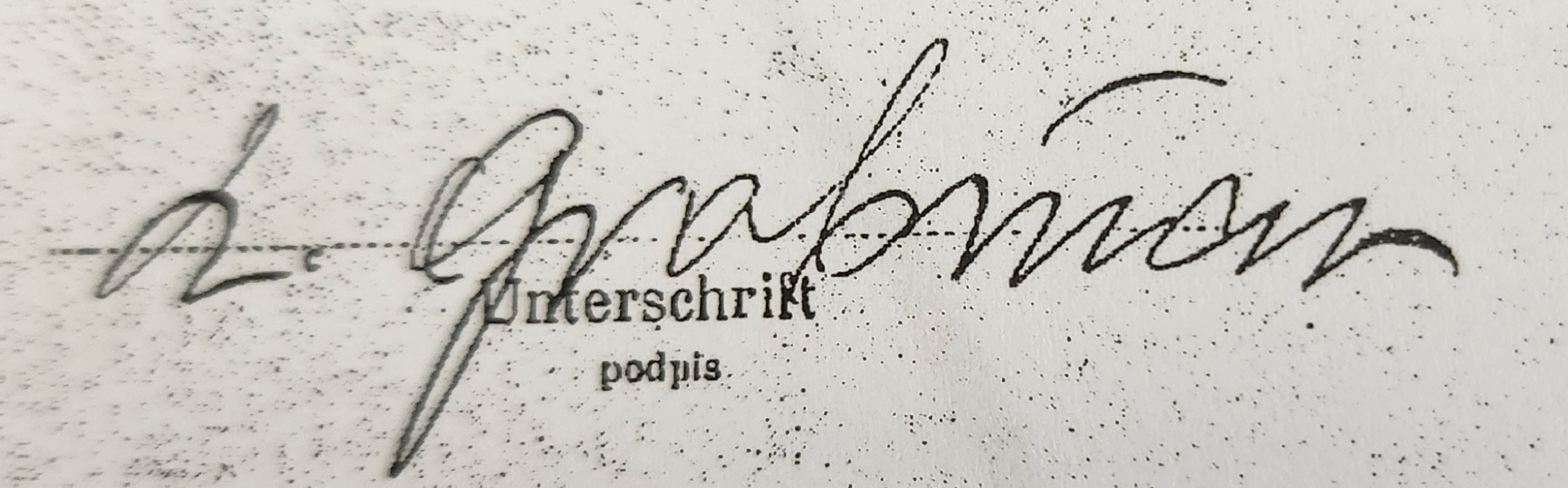
3. Signature, 1938.

4. Document: Document from Yad Vashem (In German), Cir 1940, Warsaw, Poland. Questionnaires involving declarations about their professions that were completed by Jewish physicians, nurses, technicians and dentists in the cities of Galicia and other parts of Poland, 1940-1942
5. Note, 1942, Nowy Dwor, Poland. With youth, with passion, and with two fiery eyes, he, the dentist of the town, would spring through the streets. If you asked him his age, he would look with those piercing eyes, stand on his toes, [and say]: "Why are you counting my years? I don't remember them"…. And he really did not remember them because he was always filled with a sprightly youth and always kept himself among the youth. He, this doctor, did not socialize with the pharmacist and other respected people in town; he distanced himself from all these snobs. And because of that, he was one with and close to the general folks. He shared his knowledge and experiences with them.
His home was open to everyone. All kinds of issues were discussed there. A school of knowledge in Jewish and all people's problems was there \endash in his home.
As a connoisseur and lover of Yiddish literature he took special pleasure in organizing literary Friday nights, and to those tired and hard\endash working from an entire week, he would read chapters from Shalom Aleichem. And how he read that! He prayed [recited with such fervor] the great humorous classic, and recited with all his limbs.
He would direct the drama circles in the city. This he also did in his home.
With the establishment of the education association after World War One, Shmuel Grabman would come there every evening to teach the workers and general population to read and write, and then guide them into Yiddish literature. His readings attracted all segments of the Jewish population. Wherever there was an opportunity \endash the roaring Shmuel Grabman participated. He was co\endash founder and chairman of the large Sholom Aleichem library, supporter and co\endash founder of the beautiful Yiddish school\endash organization, and for many years was also councilman in the city council, where his proud appearances were something renowned. With dignity, he would refute all anti\endash Semitic attacks; he would evoke respect and honor from all strata of the population.
On my walks with him, he would not tire from discussing all kinds of issues, and you could feel his sincerity in this: to enrich the other person with the treasures of his knowledge. He had an extraordinary love for everyone who heard him.
When I was preparing, in 1934, to go to Israel, and I came to say goodbye to him, there were tears in his eyes. He held me with both his hands and said: "Who knows, friend Sholom, what sort of fate awaits us here. You've accomplished your dream and are going towards your goal. I don't know if everything will be fulfilled, but I am still envious of you because you believe. Go, and have good fortune…"
In 1936, when I came to visit Nowy Dwor, I saw him, Shmuel Grabman, for the last time one evening in at the location of Poalei Tzion. He was participating in a discussion about the civil war in Spain, with the same fire and youth, but his voice was trembling when he moved to the discussion of the situation in Poland at that time. After the speech, we walked through the city garden until late at night. The moon lit up the tips of the church, and he said: "These tips, which the moon is lighting up \endash should not one day harm our bodies. They are frightening me more than ever." I heard him and it remained in my memory as prophetic speech.
During that walk in the city garden, he suddenly moved closely to me and bending over, he said: "Chaver [friend, comrade] Sholom, is it possible for a person like me, at my age, to work in my profession and earn at least some bread in the Land of Israel? It's important to think of this because here the noose is getting tighter around the neck…" I comforted him and replied that you have to believe that anything is possible. Then I felt the enormous struggle that went on in the soul of the eternally young Shmuel Grabman.
Three years later, he shared the fate with all the other Jews in Poland. But the proud, dignified Shmuel Grabman, in the most difficult days, encouraged dear and friendly ones, and continued to read Sholom Aleichem to them… And when the final hours came, and when they came to take him to Treblinka, at the very last minute he swallowed cyanide poison, and with the outcry: "The murderous Hitler hands will not take me!" the over sixty\endash year\endash old Shmuel Grabman, dear friend and huge philanthropist, ended his life.
(Shmuel Grabman by Shlomo Korcowicz)
Shmuel married Jenta WOLICKA, daughter of Szajndla WOLICKA and Tema UNKNOWN. (Jenta WOLICKA was born on 7 December 1872 in Nowy Dwor, Poland and died in Warsaw, Poland.)
|
